Mrs. Phelps
Mrs. Phelps is one of Mildred Montag's friends who visits the Montag home one evening, a woman whose life and conversation reveal the hollow core of a society built on distraction and the suppression of feeling. She arrives with Mrs. Bowles, both of them swept into the house "like a monstrous crystal chandelier tinkling in a thousand chimes," their voices immediately filling the space with chatter that is all surface and no substance. She is introduced as Clara by Mildred, though the narrative consistently refers to her by her married name, Mrs. Phelps, a designation that underscores her identity as defined by a husband who is barely present.
Life, Marriage, and Children
Mrs. Phelps's attitudes toward family, war, and human connection are a catalogue of the society's values. She has no children, declaring with indignation that "no one in his right mind, the Good Lord knows; would have children!" When Mrs. Bowles boasts of her two Caesarian-section births, Mrs. Phelps dismisses children as "ruinous." Her marriage to Pete is a model of emotional detachment: she describes their arrangement as "independent," explaining that Pete told her, "if I get killed off, you just go right ahead and don't cry, but get married again, and don't think of me." She reports this with a giggle, adding, "I'll let old Pete do all the worrying. Not me. I'm not worried." When Montag asks when the war will start, noting that her husband is not present, she replies that the Army called Pete yesterday and promised a quick war—"Forty-eight hours they said, and everyone home." She has never known anyone killed in a war, only in suicides like Gloria's husband who jumped off a building. Her casual acceptance of violence and death is matched by her political opinions: she voted for President Noble because he was "one of the nicest-looking men who ever became president," while his opponent, Hubert Hoag, was "kind of small and homely" and mumbled.
The Reading of "Dover Beach"
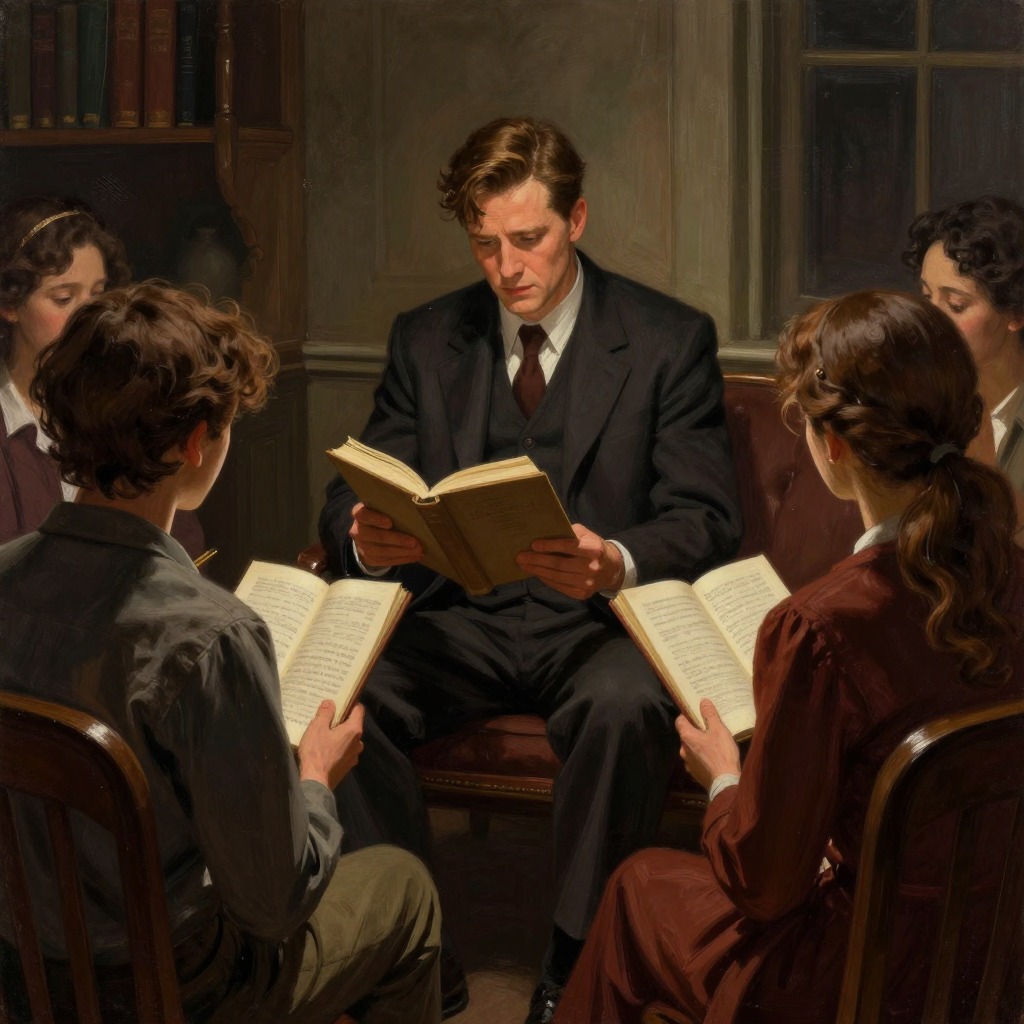
The pivotal moment of Mrs. Phelps's appearance comes when Montag, goaded by the women's empty talk, produces a book of poetry and reads Matthew Arnold's "Dover Beach" aloud. The poem's meditation on the retreat of faith and the darkness of the modern world—"And we are here as on a darkling plain / Swept with confused alarms of struggle and flight, / Where ignorant armies clash by night"—strikes Mrs. Phelps with unexpected force. She begins to cry, her sobs growing "very loud as her face squeezed itself out of shape." The other women sit bewildered, not touching her, unable to comprehend her display. Mildred tries to comfort her, saying "You're all right, Clara," but Mrs. Phelps can only sob, "I-I don't know, don't know, I just don't know, oh oh..." Her tears are a spontaneous, uncomprehending response to a beauty and truth her culture has trained her to reject, and they reveal a reservoir of grief she cannot name.
Aftermath and Significance
Mrs. Bowles reacts with fury, declaring that poetry causes "tears and suicide and crying and awful feelings" and calling Montag "nasty." Mrs. Phelps herself is led away by Mildred, still crying, as Mrs. Bowles vows never to return. Montag, shaken by what he has done, later reflects that he "made them unhappier than they have been in years" and feels guilty. Faber, speaking through the green bullet, tells him not to apologize: "If there were no war, if there was peace in the world, I'd say fine, have fun! But, Montag, you mustn't go back to being just a fireman." Mrs. Phelps's brief breakdown is the novel's most direct evidence that the society's enforced happiness is a lie, and that the capacity for genuine feeling—even painful feeling—survives beneath the surface of conformity. Her tears are a small, involuntary act of rebellion, a crack in the wall of denial that the culture has built around itself.